
Lesson 5 - Sat Nam, Stress Reduction
An Introductory Course, Designed and Written by Guru Rattana, Ph.D.
Mantras
Mantras are sounds that connect us with different levels of consciousness. SAT NAM is the most basic mantra used in Kundalini Yoga. (pronounced like "but mom") SAT means the truth. NAM means name, identity, to identify with or to call upon. SAT NAM can be translated as "Truth is God's Name. Truth is my (your, our) identity." It is used as a greeting to acknowledge the Truth in each one of us and as a personal mantra to express or tune into one's infinite identity.
SAT NAM is an invocation of our divine consciousness. Its vibration links us up to our true identity, which is our divine soul. SAT NAM is called the seed or bij mantra. By chanting this mantra we plant the seed of universal truth in our consciousness.
We all know the axiom "The truth shall set you free." The question is how do we link up with the Truth. SAT NAM is one mantra that links us up with the Truth. SAT NAM has the power to set us free by waking us up to our infinite identity and connecting us to universal oneness.
SAT NAM has the power to clear the subconscious mind so that old wounds and programs no longer get in the way of Self-realization. It does so by changing the projection of our minds. Mantra means the projection of the mind. "Bij" or seed mantras use universal sound currents to rearrange the habit patterns of the mind. They do so by accessing the part of the mind that regulates habits. The sounds erase patterns that vibrate at lower frequencies or do not resonate with the Truth or our true essence. They establish new habits by replacing the old frequency with the higher frequency of the Truth. SAT resonates with universal Truth. NAM "is the vibration which creates what it names."
(Kundalini Yoga: The Flow of Eternal Power, by Shakti Parwha Kaur Khalsa).
Breathing - Pranayama
The science of breathing is called Pranayama. Pranayama is an integral part of Kundalini Yoga and Meditation. In this lesson we will offer a few basics that will help you begin to be aware of your breath and to integrate conscious breathing into your daily life and yogic practice. In lesson 7 we will go into aspects of Pranayama in much greater detail.
The breath and the state of the mind are intricately linked. We can control our minds by controlling our breath. Most of us breathe very shallow breaths and take from 15 or more breaths per minute. Breathing more that ten breaths per minute creates a state of stress. People who suffer from panic attacks not only breathe quickly and shallowly. They also often breathe through their mouths.
To create a state of peace and relaxation we must breathe less than 10 breaths per minute. Breathing four or less breaths per minute induces a state of meditation.
Whenever you want to calm down, paying attention to your breath is the first step. Notice if you are inhaling and exhaling through your mouth or nose. Generally you should be breathing through your nose. Notice where you are breathing in your body. How far down do you breathe? Do you breathe in the belly, chest or neck? How many times do you breathe per minute? Time yourself.
One Kundalini Yoga technique is to link the breath with a mantra. The most basic mantra is SAT NAM. A powerful pranayama technique is to mentally link SAT to every inhale and NAM to every exhale. In this way the breath and the mantra work together to calm us down, energize and purify us and link us to our true identity. With practice you may naturally hear SAT on your inhale and NAM to your exhale. It is very profound to realize you are breathing your truth with every breath.
The Call of the Soul - Long Sat Nams to Neutralize Tension
The simplest and most basic meditation in Kundalini Yoga is chanting long SAT NAM's.
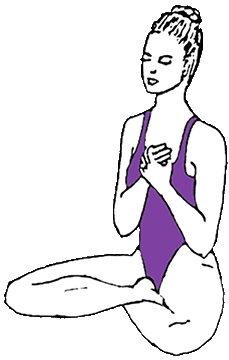
Sit with a straight spine, either in easy cross-legged easy pose, in your preferred meditation posture or in a chair with the feet on the floor, sit bones carrying the weight of the body.
Bring the hands to the heart, palms facing the chest, left hand on top of right. Place the left thumb in the center of the right palm. The fingers of both hands are together and straight. The hands gently rest against the chest, arms are relaxed on the body.
Eyes are 9/10 closed to begin with. As the meditation progresses, they may close completely.
Inhale with a long deep breath. On the exhale chant out loud SAAAAAAAAAAAAAAAAAAAAAAAAAAAAAAAAT. At the end of the breath say NAM.
Notice that your breath gets longer and deeper. You may slow your breath down to 2 per minute.
SAT is the liberator and the cleanser. Let yourself relax and release with the AAAAAAA. NAM is like the anchor. Feel the sound anchor you in your body. Then inhale deeply again and continue.
Feel the sound of the AAAAAA come from the heart. Experience your throat as the mouthpiece of your heart. This practice will help you locate, consolidate and open up the fourth (heart) and the fifth (throat) chakras. SAT NAM is the call of the soul. As you chant call out to your soul, sing to your soul. Singing to your soul creates a very peaceful feeling. It takes us out of duality for a moment as our personality and soul merge as one in the sound current of our infinite being. Feel free to express any emotions that come up. This is a good way to release and balance the emotional body. Your emotional energy will gently merge into soul energy.
At the end of the meditation, inhale deeply, hold the breath as long as you wish. Listen inside and be one with the experience.
Do this 3 times. Then sit quietly or lie down and completely relax. Begin with 3 to 5 minutes and build to 11, 15, 22 or 31 minutes.
This is one of over 100 sets and meditations to be found in Relax and Renew by Guru Rattana, Ph.D.
Benefits
This is a very relaxing meditation. It completely neutralizes tension and brings you to a very peaceful state. It is good to do if you feel overwhelmed with your daily activities or have too much intense energy in your body. Do it for 40 days and you can revitalize your glandular system and re-establish your glandular equilibrium. This is a good meditation to do at the end of a busy day. Do it when you get home after work before dinner and you will be able to enjoy your evening. Do it before you go to bed and you will sleep like a baby.