
Lesson 16 - Bedtime Meditation
An Introductory Course, Designed and Written by Guru Rattana, Ph.D.
Many people have difficulty going to sleep even though they are tired. There are many reasons for insomnia. When the mind is too active, we have a hard time going to sleep or even if we do go to sleep, we are restless and do not sleep deeply. There are many theories and opinions about how much sleep a person needs and it certainly varies according to state of health, activity and circumstances. However, most of us would agree that the deeper and more peaceful the sleep, the more rested we feel the next morning.
There are several things that we can do to promote deeper and more restful sleep:
- Slow Down: Before going to bed, start to slow down. Walk slower. Stop heavy mental activity. Write down what you need to do the next day and leave the list in the other room. This allows you to clear your mind and lets the energy start coalescing to get what you want done accomplished. If there is something on your mind that you have not been able to resolve, make a special list for the angels, for the Divine or whoever might to around to help and turn it over to a higher, unemployed power that needs an activity for the night.
Feel complete about the day. Acknowledge yourself for what you accomplished and lessons learned. Forgive yourself for anything that bothers you. Heh, no one's perfect. And list five things you are grateful for. In other words, prepare yourself to devote the next hours to peaceful, unpreoccupied sleep. You not only deserve, you need to rest. - Eating Habits: Eat your last meal at least 2 1/2 hours before you go to bed. When we eat just before going to bed our energy is tied up with digestion and it is hard to sleep deeply. Eat lightly for your evening meal. Definitely no animal protein, fried or heavy foods. Any dairy at night will make it more difficult to get up the next day. I used to have a small yogurt snack before going to bed. It was so painful to try to wake up in the am. When I eliminated the yogurt, it was like a weight was lifted off of me. I was so much clearer in the morning. Soups, salads, steamed vegetables or other easily digested dishes are the best for the evening meal.
- Left Nostril Breathing: The two nostrils are associated with two very different energies. When we breathe through the right nostril, we are energized and stimulated. When we breathe through the left nostril, we relax and calm down. Our breath naturally changes dominant nostrils approximately every 2-1/2 hours. After eating our nostrils will change to the left to accommodate the energy needed to digest our food. That is one reason why we feel like sleeping after eating.
You can tell which nostril is dominant at any time simply by blocking off one, then the other. The dominant one is easy to breathe through and the less dominate one feels like it is blocked.
It is useful before going to bed to sit quietly, block off the right nostril and breath long and deeply through the left nostril. Slowing down the breath to 4 or less breaths per minute also facilitates sleep.
Lying on the left side facilitates digestion and opens the right nostril. If you do need to digest your food, lying on the left side with help. However, to get to sleep, lying on your right side with help open the left nostril. You can also close off the right nostril with the right thumb to open the left nostril.
In both exercises, mentally inhale SAT and exhale NAM. The mental focus on the mantra and the breath are very soothing.
Shabad Kriya – Bedtime Meditation
Yogi Bhajan gave us the following meditation to practice before going to bed. If practiced on a regular basis, once a week or even every night, your sleep will be deep and relaxed. The control of the rhythm of the breath strengthens the nervous system and regenerates the nerves. After a few months, the rhythm of your breath will be subconsciously regulated and eventually you will internally chant the mantra while you are sleeping. You may wake up to the internal chant of the mantra and hear it in your daily activities. You will think better, work better, share better and love better. "There cannot be enough praise of the meditation's effect on the personality. It gives the mind the power to stretch to infinity, promotes radiance, patience and practical universality."
(Relax and Renew - Guru Rattana, Ph.D. - p. 118)
This is a good meditation to do to recover from fatigue caused by normal daily stress, travel and even jet lag.
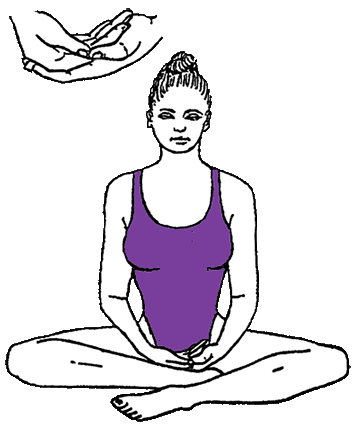
Directions:
MUDRA - HAND POSITION
Sit in Easy Pose with a straight spine. Hands are in the lap in Buddha Mudra: palms up, right hand resting on top of left. The thumbs touch and face forward.
EYES
The eyes focus at the tip of the nose with the eyes about 9/10th closed. There are several ways to facilitate looking at the tip of the nose. Bring your forefinger in front of your face and look at it. Keep looking at the forefinger and slowly bring the forefinger to the tip of the nose.
To facilitate the concentration at the tip of the nose, do the following exercise. Bring the arms out to your sides parallel to the ground, palms up. Do Breath of Fire for 1-3 minutes. This exercise balances the right and left hemispheres of the brain, which makes it easier to maintain the focus of the two eyes.
The eyes focused at the tip of the nose causes the optic nerves to cross at the third eye. Thus it is easier to bring your mental focus to the third eye while the eyes are directed at the tip of the nose. Both the pineal and the pituitary glands and the area between them are stimulated by this eye posture, which has the effect of breaking old habits and creating new ones.
Breathing and Mantra:
Inhale 4 equal parts through the nose, i.e. the inhale is divided into 4 sniffs. Mentally vibrate SA TA NA MA with the four parts of the inhale breath.
Hold the breath and mentally repeat 4 repetitions of SA TA NA MA. This will be 16 counts
SA TA NA MA SA TA NA MA SA TA NA MA SA TA NA MA
Then exhale in 2 equal strokes, mentally projecting WAHE GURU
WAHE GURU means ecstasy. WAHE GURU is the result of integrating SAT NAM into the psyche. When we experience the Truth, we feel ecstasy.
Time:
Continue for 11, 15, 22, 31 or even 62 minutes. This meditation will often put you to sleep before you complete the allotted time.
This meditation was originally taught by Yogi Bhajan April 1, 1974.